 Digital Sense

You do quality work. Your past customers love you. Yet some months the phone rings off the hook, and others you’re wondering where the next job is coming from.
Here’s the hard truth for contractors across Canada: the best roofer in Calgary doesn’t win the job. The one homeowners find first, trust fastest and hear back from soonest does.
This guide covers 15 marketing ideas built for Canadian contractors, from free wins you can set up this week to paid campaigns, seasonal plays and the rules you need to follow. Whether you run HVAC trucks in Ottawa, a renovation crew in the GTA or a landscaping and snow-removal business in Winnipeg, you’ll find ideas you can put to work.
Quick answer: The best marketing ideas for contractors in Canada are: a complete Google Business Profile, Google Local Services Ads (pay per lead), a fast website with service and city pages, a steady stream of Google reviews, replying to every enquiry within minutes, before-and-after job photos and video, branded trucks and yard signs, a referral program, and seasonal campaigns that match Canada’s weather. Start with the free ones, then add paid ads once you can answer every lead fast.
15 contractor marketing ideas at a glance
Not every idea fits every business. Use this table to pick your first three: start with the free, fast ones, then layer in paid channels.
| # | Idea | Cost | How fast it works | Best for |
|---|---|---|---|---|
| 1 | Optimized Google Business Profile | Free | Weeks | Every contractor |
| 2 | Google Local Services Ads | Medium (pay per lead) | Days | HVAC, plumbing, electrical, roofing, general contracting |
| 3 | Service and city pages on your website | Low to medium | Months | Anyone serving several towns |
| 4 | Google Search Ads | Medium to high | Days | Urgent, high-value jobs |
| 5 | Facebook and Instagram ads | Low to medium | Days to weeks | Renovations, landscaping, decks, kitchens |
| 6 | Review generation system | Free | Weeks | Every contractor |
| 7 | Referral program | Low | Months | Trades with loyal repeat clients |
| 8 | Instant text-back and fast follow-up | Low | Immediately | Anyone paying for leads |
| 9 | Maintenance plans and repeat-work reminders | Low | Months | HVAC, plumbing, landscaping, pest control |
| 10 | Before-and-after photos and short videos | Free to low | Weeks | Renovations, roofing, landscaping, painting |
| 11 | Truck wraps and jobsite yard signs | Medium (one-time) | Ongoing | Every contractor working in neighbourhoods |
| 12 | Local partnerships and home shows | Low to medium | Months | Remodellers, builders, specialty trades |
| 13 | AI search visibility (AEO) | Free to low | Months | Anyone who wants AI assistants to recommend them |
| 14 | Rebate and financing messaging | Free | Weeks | HVAC, insulation, windows, heat pumps |
| 15 | Seasonal campaigns | Low to medium | Each season | Every Canadian contractor |
Cost guide: Free = your time only. Low = under a few hundred dollars a month. Medium = a few hundred to a few thousand. High = several thousand or more.
Image placeholder: infographic of the 15 ideas grouped as Get found, Win trust, Convert and Keep customers. Alt text: “15 marketing ideas for contractors in Canada grouped by goal.”
Ideas 1–2: Get found on Google first
When a furnace quits in January, nobody flips through a flyer. They grab their phone and search “furnace repair near me”. The contractors in the map pack and the sponsored listings above it get the call.
1. Turn your Google Business Profile into a lead machine
Your Google Business Profile is the free listing that puts you on Google Maps and in the local 3-pack. For most contractors, it’s the single biggest source of free calls.
- Pick the right primary category. “Roofing contractor” beats “Contractor”. Add secondary categories for real services, like “Gutter cleaning service”.
- Set your service areas. Hide your home address and list the cities you serve, such as Mississauga, Brampton and Oakville.
- List every service with a short description. “Heat pump installation” and “Furnace repair” each match different searches.
- Upload job photos every week. Real crews, real trucks, real before-and-after shots.
- Post seasonal offers like a fall furnace tune-up or spring deck staining special.
New to this? Our step-by-step guide How Do I Get My Business on Google? [link to post once live] walks through setup and verification.
2. Run Google Local Services Ads (pay per lead, not per click)
Local Services Ads (LSAs) sit at the very top of Google, above regular ads, with a trust badge beside your name. You pay only when a customer calls or messages you through the ad, not for clicks. You can dispute leads that are spam or outside your service area.
They’re available in Canada for many home service categories, including HVAC, plumbing, electrical, roofing, landscaping and general contracting, though availability varies by trade and city. To qualify, Google may screen your business with background checks, licence checks and proof of insurance, and you need a matching Google Business Profile. Have your provincial licences (like TSSA certification for gas work in Ontario), liability insurance certificate and business registration ready before you apply.
| Local Services Ads | Google Search Ads | |
|---|---|---|
| You pay for | Leads (calls and messages) | Clicks |
| Position | Very top of results | Below LSAs |
| Trust badge | Yes, after screening | No |
| Setup time | Weeks (verification) | Days |
| Control over keywords | Low | High |
| Best for | Steady, local service calls | Specific high-value jobs and promotions |
Pro tip: LSA rankings lean heavily on your reviews and how quickly you answer. Missed calls hurt you, so set up call forwarding to a phone someone actually answers.
Want this handled for you? See our Google and local visibility service.
Idea 3: Build a website that turns visitors into quote requests
Your website is your 24/7 estimator. Homeowners check it before they call, after they see your truck and while comparing three quotes. If it’s slow, vague or hard to use on a phone, they move on.
3. Create service pages and city pages
One “Services” page listing everything won’t rank. Give each main service its own page, and each main city its own page, so Google can match you to specific searches.
| Page type | Example | Searches it can win |
|---|---|---|
| Service page | /furnace-repair/ | furnace repair, furnace not turning on |
| City page | /hvac-contractor-ottawa/ | HVAC contractor Ottawa, heating company Kanata |
| Service + city page | /roof-replacement-calgary/ | roof replacement Calgary, hail damage roof repair Calgary |
| Project page | /projects/basement-renovation-etobicoke/ | basement renovation ideas Etobicoke |
| FAQ / cost guide | /how-much-does-a-deck-cost-in-ontario/ | deck cost Ontario, how much is a deck in 2026 |
Write each page for real people: what the job involves, how long it takes, typical price ranges, photos from that area and a clear next step. Never copy the same page and swap the city name; Google treats that as thin content.
Must-haves on every contractor website
- Click-to-call phone number at the top of every page on mobile
- Short quote form (name, phone, postal code, job type, photo upload)
- Licences, insurance and associations shown clearly, such as WSIB clearance in Ontario, WCB coverage in other provinces, TSSA, ESA or your local home builders’ association
- Real project photos with the neighbourhood named
- Reviews pulled from Google
- Financing and rebate information if you offer it
- Fast load time on mobile data
Image placeholder: mobile screenshot of a contractor homepage with a click-to-call button and a 4-field quote form. Alt text: “Contractor website with a click-to-call button and short quote form on mobile.”
See how we build websites designed to bring in quote requests.
Ideas 4–5: Use paid ads to fill gaps in your schedule
Free marketing compounds over time, but it’s slow. Paid ads let you turn the tap on when you have open crews and off when you’re booked solid.
4. Google Search Ads for high-intent jobs
Search ads catch people actively looking: “emergency plumber Hamilton”, “roof leak repair”, “kitchen renovation quote”. You choose the keywords, the cities and the hours, so you can push profitable jobs and skip the ones you don’t want.
Tips that save contractors money:
- Target only the cities and postal areas you actually serve.
- Add negative keywords like “jobs”, “salary”, “DIY” and “course”.
- Send each ad to a matching service page, not your homepage.
- Run ads only when someone can answer the phone, or pair them with instant text-back.
Curious about budgets? Read how much Google Ads cost for a small business.
5. Facebook and Instagram ads for visual, planned projects
Nobody searches for a backyard makeover until they see one. Meta ads work best for projects people plan and dream about: kitchens, basements, decks, landscaping, fences and exterior painting.
- Show short before-and-after videos from real local jobs.
- Target homeowners within your service area.
- Use a simple lead form that asks for name, phone, postal code and project type.
- Retarget people who visited your website but didn’t request a quote.
| Factor | Google Search Ads | Facebook and Instagram Ads |
|---|---|---|
| Buyer intent | High (actively searching) | Lower (discovering) |
| Best trades | Emergency and repair: HVAC, plumbing, electrical, roofing | Planned projects: renovations, decks, landscaping, painting |
| Creative needed | Text ads and a strong landing page | Photos and short videos |
| Lead quality | Usually higher | Varies; needs fast follow-up |
| Speed to results | Days | Days to a few weeks |
Not sure where to start? Our guide Google Ads vs. Facebook Ads: which is better for small business? breaks it down, and our paid advertising team can manage it for you.
Ideas 6–7 and 9: Turn happy customers into your sales team
Inviting a contractor into your home takes trust. Reviews and referrals give homeowners that trust before you ever knock on the door, and repeat work is the cheapest job you’ll ever win.
6. Build a review system, not a review wish
Most contractors get reviews by accident. The ones who dominate the map pack ask every single time.
- Ask at the high point: right after the final walkthrough, when the customer is smiling at the finished job.
- Make it one tap: text them your direct Google review link the same day.
- Prompt for detail: “Mentioning the service and your neighbourhood helps other homeowners find us.” Reviews like “Great furnace install in Barrhaven” help you rank.
- Reply to every review within 48 hours, good or bad.
- Never buy reviews or pay for them. Google removes fake reviews, and Canada’s Competition Bureau treats fake or misleading reviews as deceptive marketing.
Got a harsh one? Use our templates for responding to negative Google reviews, or let us set up a reviews and reputation system for you.
7. Launch a simple referral program
Word of mouth is still king in the trades. A referral program just makes it happen on purpose.
- Offer a clear reward: a gift card, a discount on the next service or a donation to a local charity.
- Hand out referral cards at the end of every job and include the offer in your invoice email.
- Thank every referrer personally, even if the lead doesn’t book.
- Build relationships with realtors, property managers, interior designers and other trades who can send you work.
9. Sell maintenance plans and remind past customers
Your past customers already trust you. Keep them close with:
- Maintenance plans: annual furnace and AC tune-ups, spring and fall yard clean-ups, gutter cleaning, sump pump checks.
- Seasonal reminders by email or text: “Time to book your fall furnace tune-up.” Make sure you have consent first (see the CASL section below).
- Anniversary check-ins: “It’s been a year since your new roof. Want a free inspection?”
Maintenance members are easier to book in slow months and more likely to choose you for the big replacement job later.
Idea 8: Answer every lead in minutes, not tomorrow
This is the idea most contractors skip, and it’s the one that wastes the most money. You can rank first and run perfect ads, but if a lead hits voicemail at 6 PM and nobody calls back until morning, that homeowner has already booked someone else.
According to Digital Sense, 78% of buyers go with the business that responds first, while the average business takes 42 hours to reply to a web lead. That gap is your opportunity.
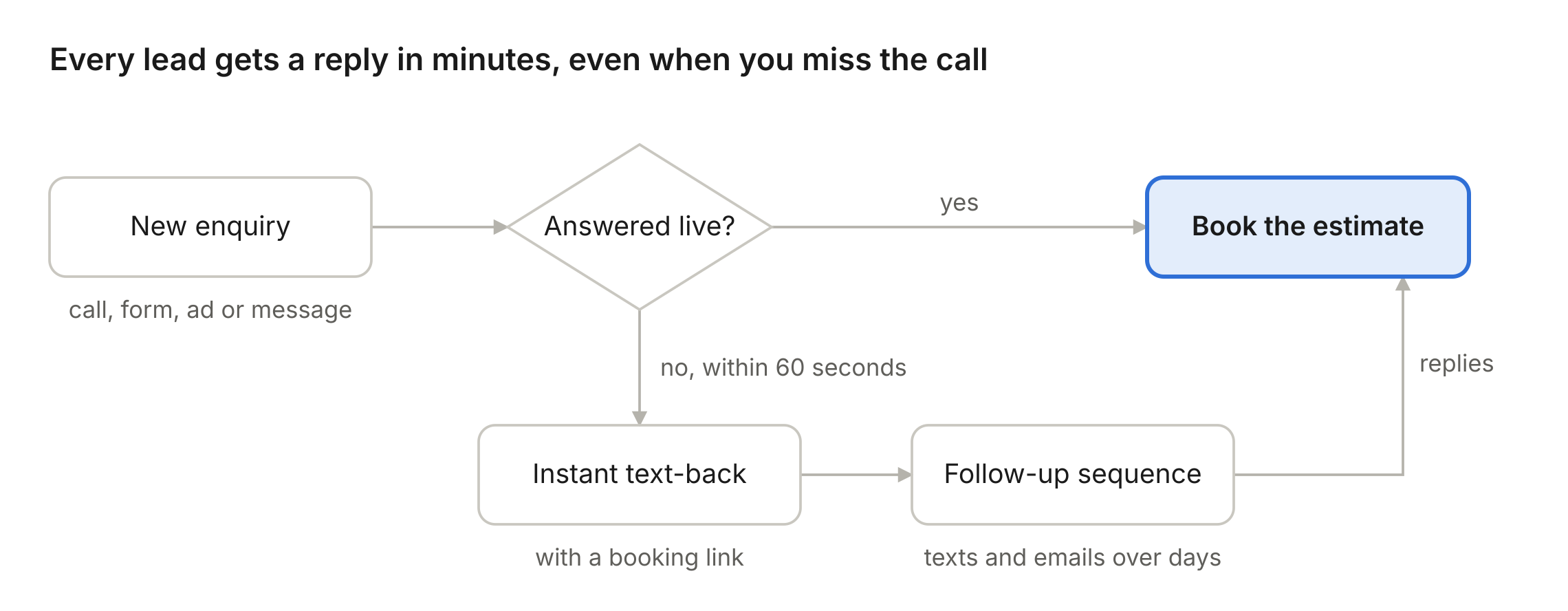
When you’re on a roof or under a sink, you can’t pick up. So let the system do it:
- Instant text-back: a missed call or form fill triggers an automatic text within seconds: “Thanks for calling ABC Heating! We’re on a job right now. Book a time here or reply with your address and issue.”
- Online booking link: let people pick an estimate slot themselves, day or night.
- Follow-up sequence: a few friendly texts and emails over the next week for people who haven’t booked.
- One place for every lead: a simple CRM so calls, forms, ad leads and messages don’t get lost in your inbox.
Real result: a 12-truck HVAC contractor was spending about 4,000 dollars a month on ads, with leads answered the next morning. After Digital Sense set up instant text-back, a booking link and a follow-up sequence, booked estimates rose 85% in 60 days on the same ad spend.
Set it up with our CRM and lead follow-up and business automation services.
Ideas 10–12: Show your work online and around town
Contracting is visual. A crooked fence made straight or a dated kitchen made new sells itself, as long as people see it.
10. Post before-and-after photos and short videos
- Snap a “before” photo at every job from the same angle you’ll use for the “after”.
- Film 15 to 30-second vertical clips: a time-lapse of a roof tear-off, a walkthrough of a finished basement, a quick tip on winterizing outdoor taps.
- Post to Instagram, Facebook, TikTok and YouTube Shorts, and add the same photos to your Google Business Profile.
- Name the neighbourhood (“New deck in Kanata”) so locals recognize the street and Google connects you to the area.
You don’t need a film crew. A phone, good light and a steady hand go a long way. When you’re ready to level up, our social and content and video teams can help.
11. Turn your trucks and jobsites into billboards
Your trucks drive through your target neighbourhoods every day. A clean, readable wrap with your logo, main service, phone number and website keeps working long after the job is done.
- Keep the design simple: readable from 15 metres at a red light.
- Add a short memorable URL or a QR code for parked trucks.
- Put a yard sign on every job (with the homeowner’s permission). Neighbours who watch the work in progress are your warmest leads.
- Follow up with door hangers on the surrounding street: “We just finished a new roof at your neighbour’s place.”
12. Partner locally and show up in person
- Home shows: National Home Show in Toronto, Calgary Home + Garden Show, BC Home + Garden Show and regional events. Bring a project portfolio and a tablet to book estimates on the spot.
- Community sponsorships: minor hockey teams, school fundraisers and local festivals build goodwill and local brand recognition.
- Trade partnerships: electricians, plumbers, designers and realtors swap referrals all the time. Make it official.
- Associations: membership in your local home builders’ association, BBB accreditation or trade groups adds trust badges you can show on your website.
Image placeholder: branded contractor truck parked beside a yard sign at a finished home renovation. Alt text: “Contractor truck wrap and yard sign marketing at a Canadian jobsite.”
Idea 13: Get recommended by AI search, not just Google
More homeowners now ask ChatGPT, Gemini or Google’s AI Overviews questions like “Who’s a reliable roofer in Halifax?” or “How much does a heat pump cost in Ontario?” These tools pull answers from websites, reviews and business listings. If your information is thin or scattered, they recommend someone else.
How to show up in AI answers:
- Answer real questions on your site. Add FAQ sections and cost guides that answer what customers ask you on every call: price ranges, timelines, permits, warranties.
- Lead with the answer. Start each answer with a clear one or two-sentence response, then add detail. AI tools quote short, direct answers.
- Keep your details consistent across your website, Google Business Profile, Facebook, Yelp, HomeStars and the BBB.
- Earn detailed reviews that mention services and locations. AI assistants summarize them.
- Add schema markup (LocalBusiness, Service and FAQPage) so machines understand your business.
| What AI tools look for | What to do |
|---|---|
| Clear expertise | Service pages with real detail, photos and credentials |
| Trust | Lots of recent, specific reviews on several platforms |
| Consistency | Same name, address, phone and services everywhere |
| Direct answers | FAQ and cost-guide content written in plain language |
| Local relevance | City pages and project pages naming real neighbourhoods |
Dig deeper with which simple AEO strategies are working right now and how important FAQs, schema markup and topical authority are, or see our AI search visibility service.
Idea 15: Run seasonal campaigns built for Canadian weather
Canadian contractors live by the seasons. The first cold snap floods HVAC lines, spring thaw brings roof leaks and wet basements, and summer is crunch time for decks and landscaping. The smartest move is to market one season ahead, so you’re top of mind before demand spikes.
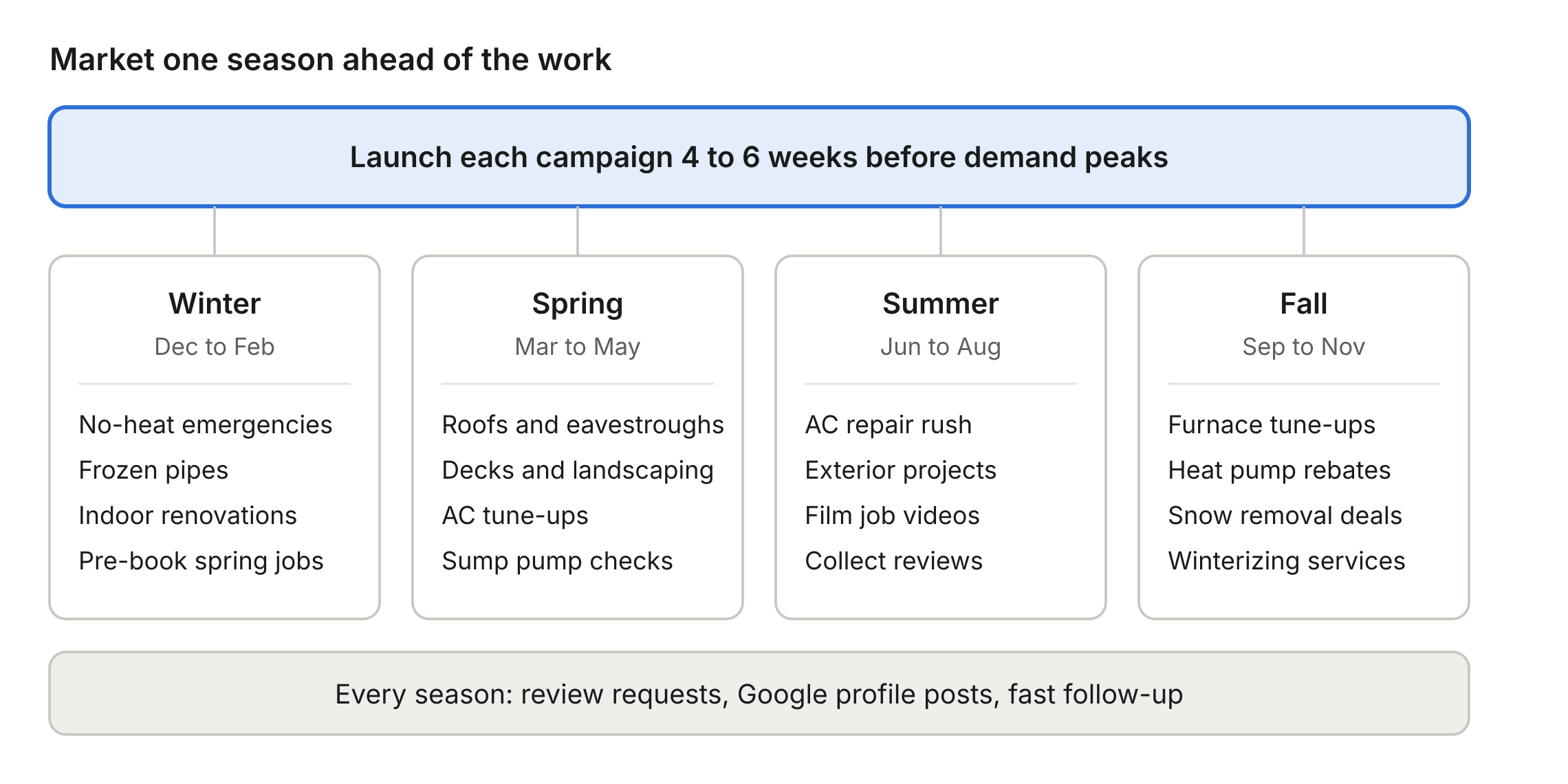
Turn slow months into planning months:
- Winter: promote emergency service and indoor work like basements, bathrooms and kitchens. Offer early-bird discounts to book spring projects now.
- Spring: launch roof inspections after hail and snow season, deck and fence campaigns, and AC tune-up reminders.
- Summer: push AC repair, capture before-and-after footage on every exterior job and ask for reviews while customers are happy.
- Fall: sell furnace tune-ups, promote heat pump rebates, sign up seasonal snow-removal contracts and offer winterizing services.
Adjust for your region. Vancouver’s rainy season, Prairie hail storms and Atlantic hurricane season each create their own demand spikes.
Idea 14 and the rules: marketing the Canadian way
Canadian contractors have opportunities and rules that US-focused marketing guides skip. Get these right and you stand out; get them wrong and you risk fines or a damaged reputation.
14. Put rebates and financing front and centre
Money is the biggest objection on big-ticket jobs. Rebates turn “maybe next year” into “let’s book it”.
On October 8, 2026, the federal government announced the National Heat Pump Rebate: up to 10,000 dollars for households below median income and 2,000 dollars for other eligible households, applied for through an online portal and stackable with provincial programs. If you install heat pumps, insulation, windows or other energy upgrades:
- Build a dedicated rebate page explaining which programs apply in your province, and keep it updated as details are released.
- Mention rebates in your ads, Google Business Profile posts and estimates.
- Offer to help customers with the paperwork; that alone can win the job.
- Promote financing options for jobs that don’t qualify.
Rebate rules change often, so link to the official program pages rather than promising specific amounts in your ads.
Follow CASL before you email or text customers
Canada’s Anti-Spam Legislation (CASL) covers marketing emails and texts. The basics, from the Government of Canada’s CASL guidance:
| Rule | What it means for you |
|---|---|
| Get consent | Ask customers to opt in, ideally with a checkbox on your quote form or contract |
| Implied consent has limits | Usually up to 2 years after a customer’s last purchase, or 6 months after an inquiry |
| Identify yourself | Include your business name and mailing address, plus a phone, email or website |
| Easy unsubscribe | Every message needs one, and requests must be honoured within 10 business days |
Penalties can reach up to 10 million dollars per violation for businesses, so build consent into your process from day one. This is general information, not legal advice.
More Canadian rules to keep in mind
- Quebec: commercial communications, ads and websites aimed at Quebec customers must be available in French under the Charter of the French Language.
- Reviews: never post fake reviews, buy reviews or hide negative ones. The Competition Bureau treats misleading reviews as deceptive marketing.
- Price claims: if you advertise “from” prices or discounts, make sure customers can actually get them.
- Credentials: only advertise licences and certifications you hold, and keep them current.
Measure what’s working (and cut what isn’t)
If you can’t say which marketing brought in last month’s jobs, you’re guessing with real money. Track a handful of numbers every month.
| Metric | What it tells you | Where to find it |
|---|---|---|
| Leads by source | Which channels actually bring enquiries | Ask every caller, use tracking numbers and form fields |
| Cost per lead | How much each enquiry costs by channel | Ad platforms plus your spend |
| Booking rate | Share of leads that become estimates | Your CRM or job software |
| Close rate | Share of estimates that become jobs | Your CRM or job software |
| Cost per booked job | The real price of winning work | Total spend divided by jobs won |
| Average job value | Whether you’re attracting the right projects | Your invoices |
| Speed to first reply | How fast leads hear back | Your CRM or phone system |
| Google Business Profile actions | Calls, direction requests and website clicks | Profile performance insights |
Rule of thumb: judge each channel by cost per booked job, not cost per lead. A 25-dollar lead that never books costs more than a 90-dollar lead that turns into a 15,000-dollar roof.
Want one dashboard for all of it? See our analytics and reporting service.
Frequently asked questions
What is the best marketing for contractors in Canada?
For most contractors, the best results come from a complete Google Business Profile, a steady flow of Google reviews, a mobile-friendly website with service and city pages, and fast replies to every enquiry. Add Google Local Services Ads or Search Ads when you need leads quickly.
How do contractors get more leads without paying for ads?
Optimize your Google Business Profile, ask every customer for a review, post before-and-after photos, put yard signs on every job, start a referral program and stay in touch with past customers through maintenance reminders.
How much should a contractor spend on marketing?
There is no single right number. A common approach is to set aside a few percent of annual revenue, then adjust based on cost per booked job. Spend more on channels that win profitable work and cut the rest.
How can contractors get work in winter in Canada?
Shift your message to indoor and emergency work: furnace repair, frozen pipes, basement and kitchen renovations, snow removal and ice dam prevention. Winter is also the time to book spring projects early with pre-season discounts.
Do I need consent to email or text past customers in Canada?
Yes. Under CASL you need express or implied consent to send marketing emails or texts. Implied consent from a purchase generally lasts up to 2 years, and every message must identify your business and include an unsubscribe option.
Should contractors use Facebook ads or Google Ads?
Use Google Ads for urgent, high-intent jobs people search for, like repairs and replacements. Use Facebook and Instagram ads for visual, planned projects like renovations, decks and landscaping.
You may also like



Want to know where your customers are slipping away?
A live look at your website, Google listing and follow-up, plus a written report in 48 hours.