 Digital Sense

Your website may explain what you sell. But does it answer what your next customer wants to know?
That gap is a useful place to start with answer engine optimization, or AEO.
You do not need to rebuild your entire website. Start by making your most useful pages clearer, more informative and easier to find.
The strategies below reflect current search guidance. They are practical actions to apply and measure not claims of guaranteed rankings or unverified client results.
What Are the Simplest AEO Strategies to Start With?
Answer real customer questions, support your advice with evidence, organize information clearly and make sure search engines can access your pages.
Microsoft recommends clear headings, useful tables, focused FAQs and evidence to help content be understood and referenced accurately in AI answers.
| Strategy | Simple action | What it improves |
| Answer customer questions | Add a direct answer beneath a relevant heading | Readers find useful information faster |
| Add original evidence | Include a real example, photograph or documented result | Your page offers more than general advice |
| Explain trade-offs | Use a comparison table where choices matter | Customers can make better decisions |
| Connect related pages | Add descriptive internal links | Readers and search engines can discover supporting content |
| Check technical access | Review indexing and crawl issues | Useful pages remain eligible for discovery |
| Maintain business details | Correct services, hours and contact information | Customers receive accurate information |
1. Answer the Question Before Making the Sales Pitch
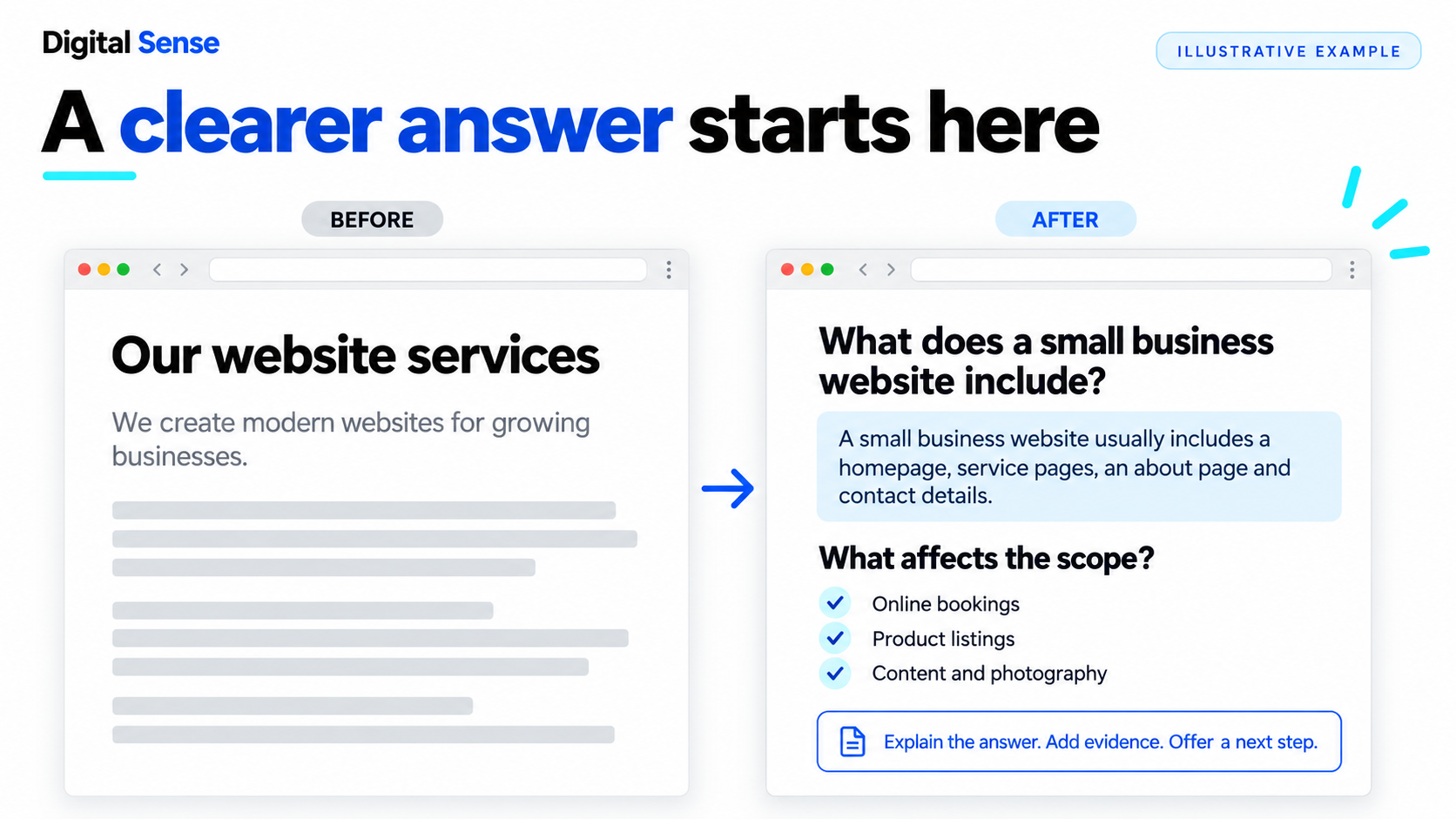
A visitor asking “What does a small business website include?” needs a useful answer before a consultation offer.
A vague opening:
We build modern websites that help businesses succeed.
A more useful opening:
A small business website usually includes a homepage, service pages, an about page and contact details. Online bookings, product listings and other features depend on what customers need to do.
Then explain the options and offer a relevant next step.
This is an editorial recommendation for clarity. There is no special sentence structure or paragraph length that guarantees an AI citation.
Insert the accompanying before-and-after visual here.
Caption: Illustrative example showing how a service page can answer a customer’s question more clearly.
2. Add Something Readers Cannot Find Everywhere Else
Another page repeating “create quality content” gives customers little reason to trust your expertise.
Add information drawn from your actual work:
- An original screenshot explaining a process.
- A project example with permission.
- A comparison based on products you have used.
- A common customer mistake and its solution.
- A documented result with dates and limitations.
Google’s current guidance emphasizes useful, original content and firsthand perspectives rather than simply repeating existing information.
For example, a web designer could explain how adding an appointment form changed the booking process. Show what changed and how it was measured. Avoid attributing every improvement to one edit without evidence.
Your experience is useful content. Make it visible.
3. Cover the Follow-up Questions That Affect a Decision
One clear answer often leads to another question.
Someone researching a website may also ask:
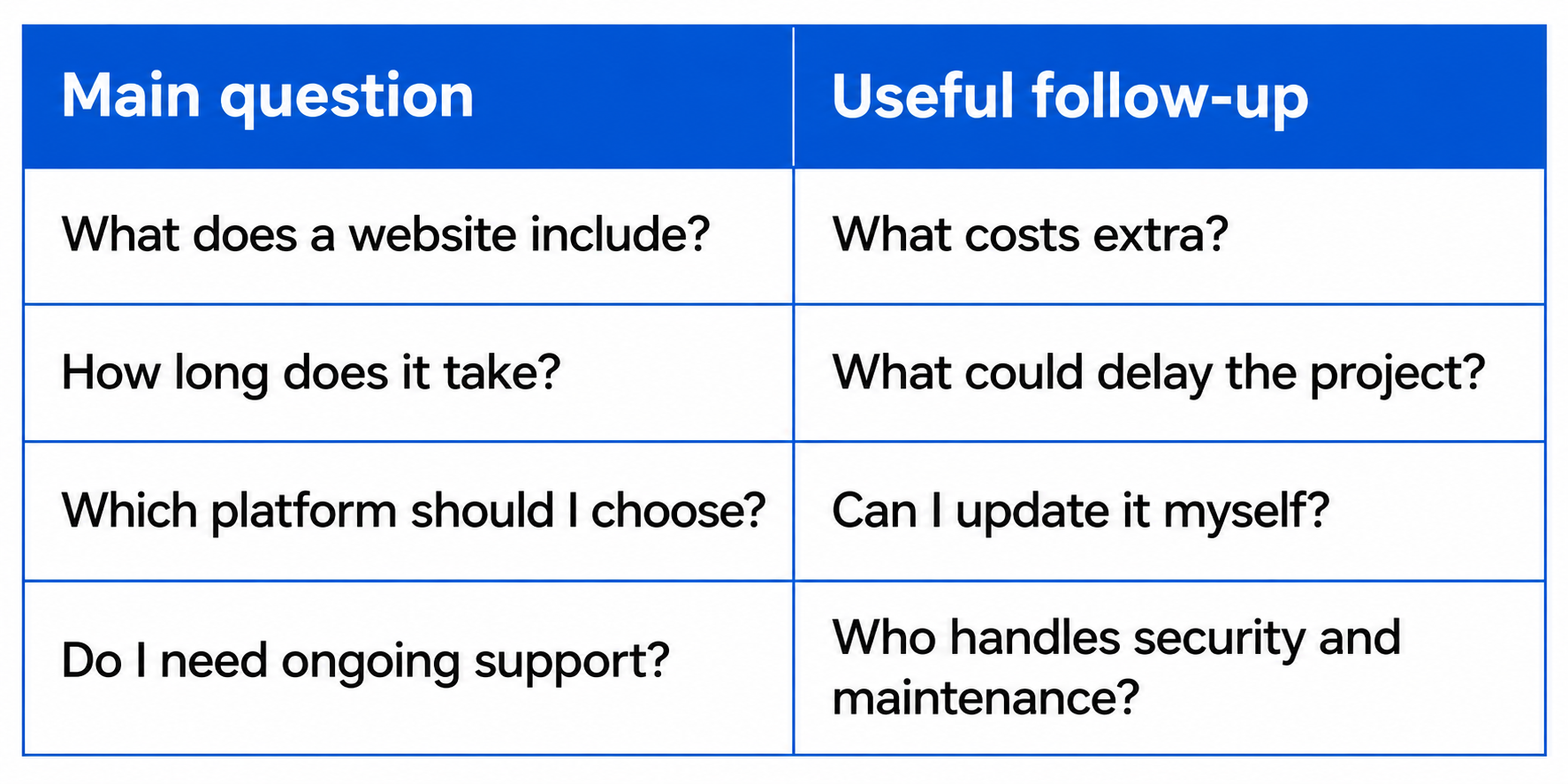
Answer closely related questions on the same page. Link to separate guides when the explanation needs more depth.
Use Reddit discussions to discover concerns and wording. Verify factual answers independently. You do not need a separate article for every slight variation of a question.
4. Connect Helpful Pages With Descriptive Links
A useful blog should lead readers toward the next relevant answer.
For example:
Explore our small business website planning guide before choosing your pages.
That link text explains the destination more clearly than “click here.” Google recommends descriptive, relevant anchor text and linking related pages within your website.
Review your key service pages. Can visitors easily reach pricing information, examples, FAQs and contact details?
If the next answer is difficult to find, improve that path.
Also Read: Can SEO Help Your Website Rank in ChatGPT?
5. Check Whether Search Engines Can Access the Page
Clear writing cannot fix a page that search engines cannot discover or index.
Check important pages for accidental indexing restrictions, broken links and crawler blocks. Keep essential service information available as page text rather than placing it only inside an image.
For Google’s AI search features, follow its current technical and inclusion requirements. Meeting them supports eligibility; it does not guarantee selection.
For local businesses, also check that your website and business profiles accurately describe your services, location, hours and contact details.
6. Measure Changes Instead of Collecting Random Screenshots
Choose a manageable set of customer questions and record a baseline before updating content.
| What to record | Why it matters |
| Prompt, platform, location and date | Gives the observation context |
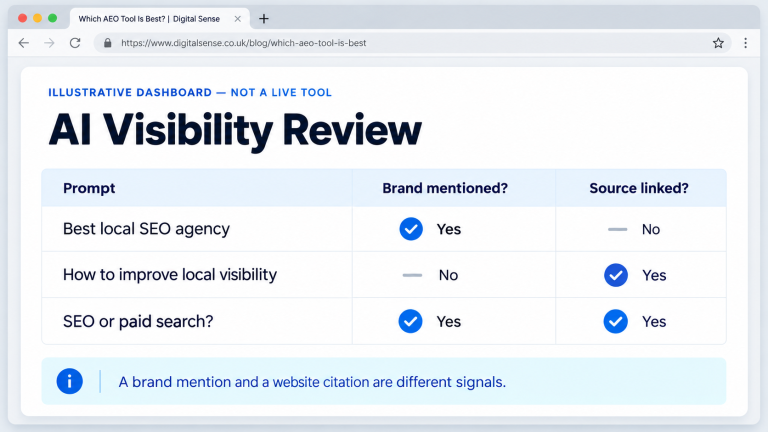
| Brand mentions | Shows whether the business is named |
| Linked citations | Shows whether your website is used as a source |
| Referral visits | Helps identify traffic reaching your website |
| Enquiries or sales | Connects exposure with business value |
Bing Webmaster Tools’ AI Performance report provides citation information across supported AI experiences. Its scope does not represent every answer engine.
A screenshot captures one observation. Repeated measurements provide a more useful picture.
Which AEO Shortcuts Should You Skip?
Avoid keyword stuffing, manufactured forum mentions and adding FAQs that repeat the entire page.
For Google, there is no required “AI schema,” ideal article length or need to break every answer into tiny sections. Its guidance also says special files such as llms.txt do not improve Google Search visibility. Other services may use different approaches.
Spend the time improving an answer customers actually need.
Turn Your Expertise Into Greater Exposure
Your business already answers valuable questions every day. Your website should do the same.
Digital Sense can help your business work toward stronger rankings and visibility in AI search results through useful content, technical SEO and clear website structure giving more potential customers opportunities to discover your services and helping your business grow.
Improve Your AI Search Visibility
Frequently Asked Questions
Is AEO different from SEO?
AEO focuses on visibility in answer-based search experiences. It overlaps heavily with SEO, including useful content, crawlability and clear website structure. It should complement your existing search work.
Can a small business do AEO without paid tools?
Yes. Start by improving important pages, checking technical access and recording customer questions. Paid monitoring becomes useful when recurring tracking or competitor analysis saves meaningful time.
How quickly will AEO strategies produce results?
There is no reliable universal timeline. Discovery, indexing, competition and answer selection vary. Review changes over time rather than promising results within a fixed number of days.
Do FAQs help businesses appear in AI search?
Relevant FAQs can help readers find answers. Include questions that add useful information. Adding an FAQ section alone does not guarantee visibility or citations.
You may also like

Want to know where your customers are slipping away?
A live look at your website, Google listing and follow-up, plus a written report in 48 hours.