 Digital Sense

Google Ads has no minimum spending commitment. For a small business, the right monthly budget depends on the price of relevant clicks, how many visitors become leads and how much a new customer is worth. As a planning example, CA 1,500 buys 300c licks at CA 5 per click, before management fees and applicable taxes.
That is the starting point. What happens after those clicks determines whether the spend makes business sense.
You do not want another bill with a report full of impressions. You want enquiries from people who need what you sell, in an area you actually serve.
This guide explains how to estimate Google Ads costs, what to include in your budget and what to check before spending more. It focuses on Search campaigns for businesses generating leads. Shopping, video and other campaign formats need their own forecasts.
How much should a small business budget for Google Ads each month?
Build your budget around the number of relevant clicks you need and their estimated cost. A monthly figure alone cannot tell you whether a campaign will generate enough useful enquiries.
The table below shows how different budgets behave at the same assumed cost per click.
| Monthly ad spend | Clicks at CA$5 CPC | Leads at an assumed 5% conversion rate |
| CA$500 | 100 | 5 |
| CA$1,000 | 200 | 10 |
| CA$1,500 | 300 | 15 |
| CA$3,000 | 600 | 30 |
Illustrative calculations, not Canadian market averages or performance forecasts. They assume the entire budget is spent and enough relevant traffic is available. Fees and taxes are excluded. A lead is not necessarily qualified or a paying customer.
At CA$10 per click, those budgets buy half as many visits. If fewer visitors enquire, the cost per lead rises further.
For a Toronto or GTA business, forecast the services and areas you actually cover. A neighbourhood salon and a contractor serving several cities should not inherit the same budget simply because both are small businesses.
Google Keyword Planner can estimate clicks and costs for your keywords and chosen locations. Use those estimates to build a starting scenario, then replace assumptions with real campaign data. Forecasts are estimates, not promises.
What does your total Google Ads budget need to cover?
Your total cost can include ad spend, campaign management, setup, landing page work and measurement tools. An agency quote should make these items clear.
| Cost component | What it pays for | What to clarify |
| Ad spend | Advertising purchased through Google | Is this separate from the service fee? |
| Campaign management | Monitoring, testing, optimisation and reporting | Is pricing fixed, percentage based or a combination? |
| Initial setup | Campaign structure, ads and measurement configuration | Is this a one-time charge? |
| Landing page work | A page designed around the advertised offer | Are creation and ongoing changes included? |
| Tracking tools | Optional call tracking, CRM or reporting subscriptions | Which subscriptions cost extra? |
| Applicable taxes | Taxes on relevant invoices | Are quoted amounts before or after tax? |
For example, CA1,500inadspendplusanassumedCA400 management fee equals CA$1,900 before setup, extras and tax. This is a calculation example, not a Digital Sense price or an industry fee benchmark.
Ask what is included before comparing providers. Two identical monthly quotes can cover very different amounts of actual advertising.
Why do Google Ads click costs vary so much?
Google Ads uses auctions rather than a universal price list. Your bids, competition, ad quality, landing page and the context of a search influence whether and where your ads appear.
Several practical differences matter:
- Search intent: Someone searching for an emergency repair may be much closer to hiring than someone reading maintenance tips.
- Location: The businesses competing for a search vary by area.
- Season and demand: Your forecast can change as demand and competition shift.
- Ad and page relevance: A specific search should lead to a relevant offer and a useful page.
For wider context, WordStream’s 2025 search advertising benchmark reported an average CPC of US$5.26 across more than 16,000 US-based campaigns running from April 2024 through March 2025. This is historical US benchmark data, not a Canadian rate card or a prediction for your account.
Use broad averages for context. Use local forecasts and your own results to make spending decisions.
Also Read: How to Choose the Right Google Business Profile Category
How can you calculate a Google Ads budget from your lead goal?
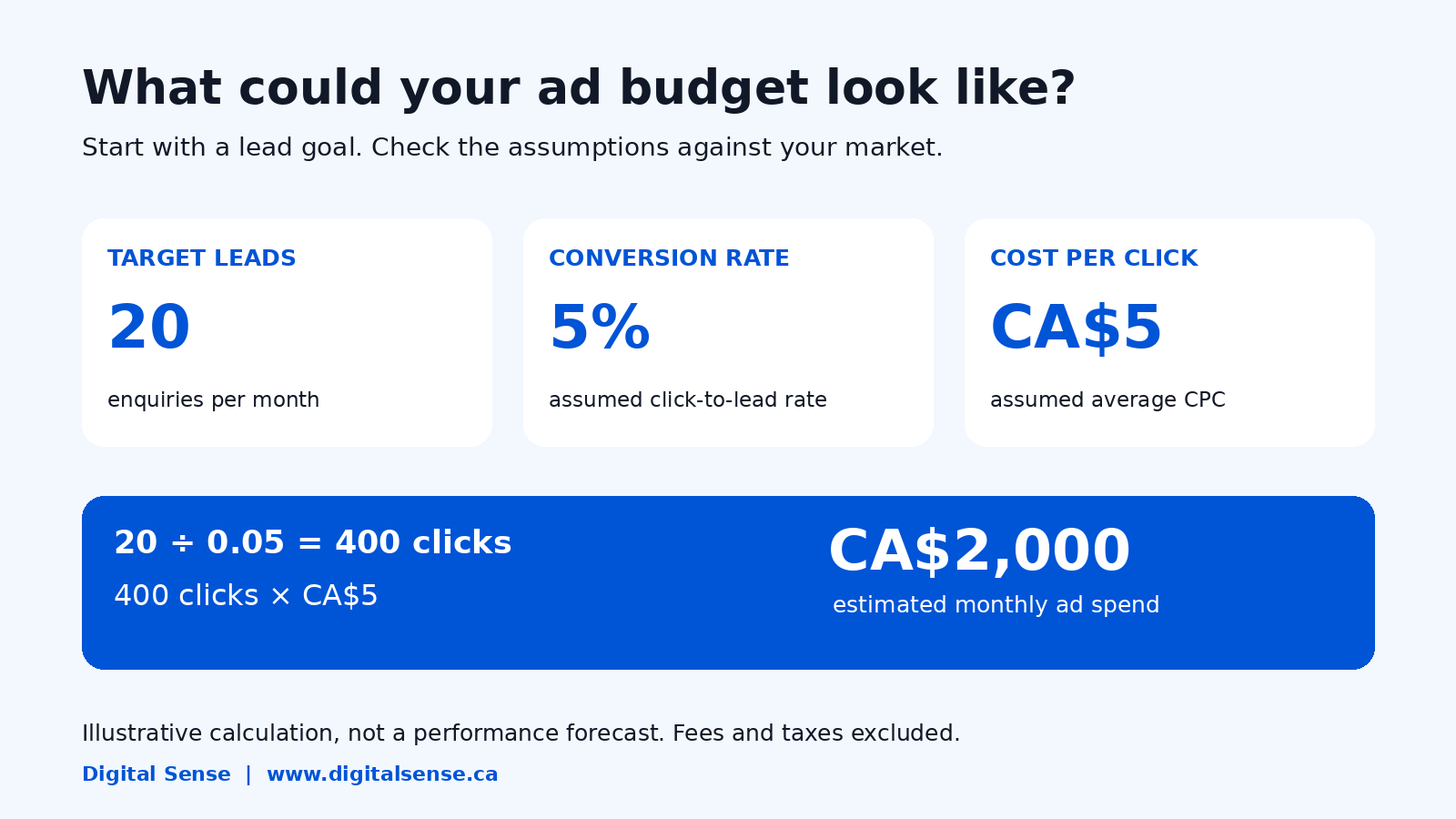
Start with your lead target, estimate the conversion rate and work backwards to the clicks required.
Required clicks = target leads ÷ click-to-lead conversion rate
Estimated ad spend = required clicks × average cost per click
Suppose you want 20 enquiries per month, expect 5% of visitors to enquire and estimate a CA$5 CPC:
| Calculation | Result |
| 20 leads ÷ 0.05 conversion rate | 400 clicks |
| 400 clicks × CA$5 CPC | CA$2,000 ad spend |
| CA$2,000 ÷ 20 leads | CA$100 cost per lead |
These assumptions create a testable plan. They do not establish what your market will deliver.
Before approving the budget, check whether you can afford CA$100 per enquiry and how many enquiries you normally turn into customers. Include lead quality, not just the number of form submissions.
How do you know whether your cost per lead is affordable?
An affordable cost per lead depends on your sales close rate and the amount you can spend to acquire a customer while retaining enough profit.
Allowable ad cost per lead = allowable ad cost per customer × lead-to-customer close rate
For example, if you can allocate CA200inadspendtoacquiringonecustomerandclose25%ofqualifiedleads,yourtargetadcostperqualifiedleadisCA50.
Keep the definitions consistent. A close rate calculated from qualified enquiries should be paired with cost per qualified enquiry, not cost per every submission.
Set the customer acquisition allowance using contribution margin after delivery costs, with room for overhead, marketing fees and profit. Revenue alone can make an expensive campaign look healthier than it is. If repeat purchases matter, use a conservative value supported by customer history.
Measure the full path from click to enquiry to paying customer. A low click price is useful only when those visits contribute to the business.
How does Google calculate daily and monthly spending limits?
For most campaigns using an average daily budget, the monthly spending limit is the daily budget multiplied by 30.4. Google can spend more on some days and less on others. For most of these campaigns, the daily spending limit is twice the average daily budget. [5]
| Average daily budget | Monthly spending limit at 30.4 days |
| CA$20 | CA$608 |
| CA$50 | CA$1,520 |
| CA$100 | CA$3,040 |
Assumes an unchanged average daily budget for a full month. Starting partway through a month or changing the budget affects the applicable limit. Some campaign arrangements have different rules.
Check the budget report when planning cash flow. It shows costs to date, the monthly forecast and the spending limit.
How can you reduce wasted Google Ads spend?
Begin by checking which searches, locations and landing pages produce useful enquiries. Raising the budget before fixing these areas can simply make existing problems more expensive.
Focus the offer. With limited spend, test a clearly defined service and area before spreading money across every part of your business.
Review actual search terms. Where irrelevant queries appear, consider suitable negative keywords. A repair company that does not sell parts may need to exclude parts-only searches. Avoid exclusions that block valuable enquiries.
Check where leads come from. Compare campaign targeting with actual enquiry locations. Investigate repeated enquiries outside your service area.
Match the landing page to the search. An ad for furnace repair should make furnace repair, coverage and the next step immediately clear. Check the page and enquiry process on a phone.
Track meaningful outcomes. Distinguish calls and completed enquiries from weaker actions such as viewing a page. Record which enquiries become qualified leads and customers.
Follow up promptly. A missed call or unanswered form can waste a relevant click. Make sure someone owns the next step after an enquiry arrives.
When should you increase your Google Ads budget?
Increase spend when tracking is reliable, leads are relevant, acquisition costs fit your margins and your business can handle more demand.
Before increasing the budget, check:
- Have enough leads completed your sales cycle to judge results?
- Are you measuring paying customers as well as enquiries?
- Are profitable campaigns constrained by budget?
- Can your team respond to and fulfil more enquiries?
Review changes against lead quality and customer acquisition cost. A larger budget does not guarantee the same average results, because additional traffic may behave differently.
Also Read: Does Responding to Google Reviews Help Local SEO?
Need help choosing a Google Ads budget for your business?
You should know what your advertising is meant to achieve before the first dollar leaves your account.
Digital Sense’s paid advertising services include Google Ads, landing pages and tracking. If you are unsure where to start, discuss your services, target locations and budget with the team.
Build a clearer plan for the clicks you buy and the enquiries that follow.
Frequently asked questions about Google Ads costs
Is CA$500 a month enough for Google Ads?
It can support a limited test when click costs and targeting allow enough relevant traffic. At an assumed CA5CPC,CA500 buys about 100 clicks before fees and taxes. At CA$20 CPC, it buys only 25. Forecast your actual market before deciding whether the test can answer useful questions.
Is there a minimum spend for Google Ads?
Google Ads has no minimum spending commitment. However, the amount needed for a useful campaign depends on click costs and the volume required to evaluate results. An agency may also have its own minimum service fee or engagement requirement. [1]
Are Google Ads management fees included in ad spend?
They are different costs. Ad spend pays for advertising, while management fees pay for campaign services. A provider may bundle them into one invoice, so request a breakdown of media spend, service fees, setup and additional charges.
Do you pay for Google Ads when nobody clicks?
With cost-per-click billing, you pay for clicks rather than impressions. Other Google Ads campaign types and billing models can charge for different interactions, so check the campaign’s charging basis. A target cost per acquisition is a bidding goal, not a promise that you pay only when you get a customer.
You may also like



Want to know where your customers are slipping away?
A live look at your website, Google listing and follow-up, plus a written report in 48 hours.