 Digital Sense
ChatGPT can find local businesses through web search and information supplied by search or local-data providers. The customer’s question, location and available sources shape the answer. OpenAI says search placement is not guaranteed. Making your business information accessible, specific and accurate is a practical starting point, not a promise of recommendations.
Imagine a homeowner asking, “Which renovation companies in Vaughan handle small kitchen projects?”
They are not simply looking for a list of contractors. They want someone who serves their area, takes on their type of project and gives them enough confidence to make an enquiry.
If your website says little more than “quality work at competitive prices,” it leaves those questions unanswered.
That is where your work begins: making it easier for a customer to understand what you do, where you do it and why your business is a suitable option.
What happens when someone asks ChatGPT for a nearby business?
ChatGPT may search automatically when current information would help. It can turn a prompt into targeted queries, consult search providers and include source citations. Location can come from the prompt, an approximate IP-based location or optional device sharing; relevant saved memories may also affect a query.
Here is an illustrative customer journey, not a disclosure of OpenAI’s internal ranking system:
| Customer question | Information worth making clear on your website |
| “Who repairs furnaces in Vaughan?” | The repair services offered and actual coverage area |
| “Which café has vegan lunch options?” | A current menu with clearly identified options |
| “Who handles small kitchen renovations?” | Project scope, relevant examples and enquiry process |
| “Is this salon open on Sunday?” | Current opening hours and booking information |
Think about what would let a person verify the answer. That same exercise improves the usefulness of the information you publish.
Is ChatGPT checking live information every time?
Do not assume every answer is a fresh business lookup. Check whether it uses search and inspect the cited sources. OpenAI warns that search results and citations can still be outdated, incomplete or wrong.
For business owners, this means a single response is a weak basis for judging visibility. For customers, it means confirming important details before visiting, booking or paying.
A café’s old opening hours might appear in an outdated directory even after its website has changed. Correcting one page cannot guarantee that every answer immediately updates.
What makes ChatGPT recommend one business instead of another?
OpenAI describes search ranking in terms of multiple factors aimed at relevant, reliable information, without publishing a complete local ranking formula.
Avoid treating an agency’s checklist as a proven weighting system. Claims such as “50 reviews guarantee a recommendation” or “this schema field puts you first” need evidence.
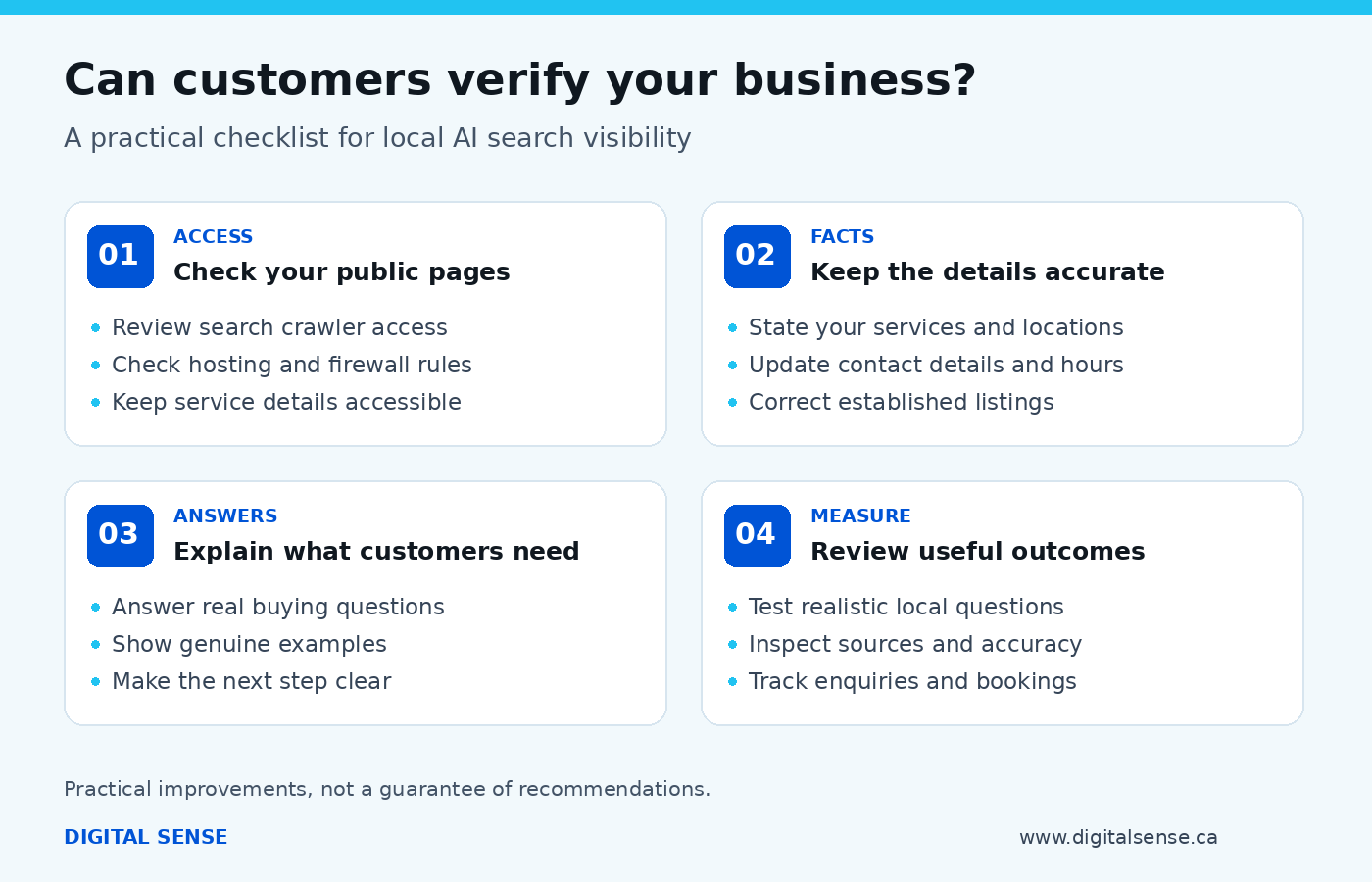
A more useful approach is to improve the information a prospective customer would need to compare businesses:
- Service fit: Describe the work you actually provide.
- Location fit: Explain your real service area or customer-facing location.
- Specific evidence: Show genuine projects, menus, qualifications or service details where relevant.
- Current information: Keep hours, contact details and availability guidance accurate.
- A clear next step: Explain how to enquire, book or request an estimate.
These are editorial recommendations for better business information. They are not confirmed individual ChatGPT ranking factors.
Also Read: How Do I Get My Business on Google? (Free Setup Guide)
Does ChatGPT simply copy Google Maps results?
Do not assume that it does. The official search documentation describes web search and third-party providers; it does not establish Google Maps as the sole source for every local answer.
That distinction matters when setting priorities. Maintaining your Google Business Profile is useful for customers who find you through Google, but it should not be your only source of accurate business information.
Keep your own website clear and maintain the established directories or industry listings your customers actually use. Avoid paying to submit your business to hundreds of obscure sites simply because someone calls them “AI citations.”
Practical example: A contractor should make its service area and project types understandable on its own site, rather than expecting a map listing to explain the entire business.
How can you make your website eligible for ChatGPT search?
OpenAI identifies OAI-SearchBot as its search crawler and recommends allowing its access, including through your host or content delivery network. GPTBot has a different purpose: crawling content that may be used for model training. Those permissions can be managed separately.
Ask your website provider to check:
| Check | What you want to establish |
| Search crawler access | Relevant public pages are not unintentionally blocked from OAI-SearchBot |
| Hosting and security settings | Firewall or bot protection is not rejecting legitimate search-crawler requests |
| Public content | Essential service information does not require a customer login |
| Working pages | Important URLs load correctly and are linked from your site |
| Information quality | The page actually explains the service, location and next step |
Opening access establishes a technical opportunity for discovery. It does not establish that a page will be chosen, cited or recommended.
Have your developer review the existing setup before changing crawler rules. Do not remove protections from private customer areas to make public service pages accessible.
What should you publish to answer local buying questions?
Publish information that helps a customer decide whether to contact you. A useful service page should answer real questions, with enough detail to be checked.
For a Vaughan renovation company, that could include:
- Whether you offer kitchen-only renovations or larger projects.
- Which nearby areas you serve.
- How you assess a new project.
- What influences the quote.
- Examples of your own completed work.
- Who handles the enquiry and what happens next.
Compare these two descriptions:
Vague: “We deliver innovative solutions with unmatched quality.”
Useful: “We renovate kitchens in Vaughan and Richmond Hill. Our estimate process starts with a discussion of your layout, preferred materials and project scope.”
Only use the second statement if it accurately describes your business. Specific information is useful because it answers a real question, not because a particular sentence format guarantees AI visibility.
If you publish prices, explain what they include. If you cannot give a meaningful fixed price, explain the factors that affect an estimate. Do not invent a low starting price just to attract enquiries.
Do reviews, directories and local mentions help?
Treat them as public evidence and customer touchpoints, not guaranteed ranking switches.
Review your established profiles for incorrect phone numbers, outdated services and inconsistent descriptions. Request genuine feedback through a fair process and follow each platform’s review rules.
Useful local coverage could include a real community project, an industry association profile or a supplier case study. Earn those mentions through actual relationships and work.
A practical audit question is: “If a customer found this page instead of our website, would they understand who we are and how to contact us?”
Do not manufacture reviews, fake local branches or fabricated awards. Those tactics make your information less trustworthy and can mislead customers.
Can Canadian businesses claim a listing in ChatGPT?
Check eligibility before building your plan around it. OpenAI’s Business Hub allows eligible businesses to manage supplied information after verification. However, its current guidance says local stores and restaurants can claim only an existing U.S. listing. Other eligibility depends on business type, location and supported verification.
Canadian local businesses should not assume a universal claim option is available. Check the current official guidance for your business category.
Claiming a business also does not guarantee more recommendations or control over independent answers. OpenAI says advertising does not influence those independent answers.
Keep improving your public website and customer information whether or not a claim feature is available to you.
How can you check whether ChatGPT is finding your business?
Use a small, repeatable review process instead of repeatedly asking it to recommend your company by name.
- Write five to ten realistic customer questions covering your services and locations.
- Test them in fresh conversations with web search available.
- Record the exact question, date, location context, mentioned businesses and cited URLs.
- Check whether each citation supports the claim being made.
- Note incorrect details and correct the original source where you can.
- Track relevant website visits, enquiries and bookings alongside these observations.
Example prompts:
- “Find kitchen renovation companies serving Vaughan that show small-project examples.”
- “Which cafés in Richmond Hill publish a vegan lunch menu?”
- “Find local painters who explain their estimate process in Markham.”
These are test prompts, not claims about actual search results.
One mention is not a stable ranking. One omission does not prove that your business is blocked. Treat the results as a sample of answers under particular conditions.
Where Business Hub insights are available after approval, they can provide aggregate mentions and website clicks. They do not expose individual customer prompts, and blank metrics need not mean zero activity.
What should you improve first this month?
| Priority | Action | Useful outcome |
| 1 | Check public-page access with your website provider | Understand whether discovery is technically possible |
| 2 | Correct service, location and contact information | Reduce conflicting or incomplete details |
| 3 | Improve one important service page | Answer actual buying questions |
| 4 | Add real project or product evidence | Help customers evaluate the offer |
| 5 | Review a fixed set of local questions | Identify incorrect information and gaps |
| 6 | Track enquiries and bookings | Connect visibility work to business outcomes |
You do not need dozens of new articles to begin. A clear, accurate page about your most important service can be a better first project than a large batch of generic content.
How can Digital Sense help improve your AI search visibility?
When a customer asks for a business like yours, your online information should make your offer easy to understand.
Start with the pages, listings and unanswered questions that matter most. Bring those to Digital Sense to discuss a practical plan for your website, local visibility and enquiry journey.
The goal is meaningful visibility backed by clear information and a useful next step for the customer.
Frequently asked questions
Do I need to allow GPTBot to appear in ChatGPT search?
No. OpenAI separates training-related GPTBot permissions from OAI-SearchBot permissions for search. A website can allow the search crawler while disallowing GPTBot. Check your full hosting setup as well as robots.txt.
Will an llms.txt file make ChatGPT recommend my business?
The cited OpenAI search guidance does not establish llms.txt as a requirement or a recommendation guarantee. Prioritize accessible public pages and accurate business information before treating an extra file as an essential marketing investment.
Can I pay to be included in ChatGPT’s independent recommendations?
OpenAI says advertising does not influence its independent answers. A paid campaign and an independent recommendation are different things; do not accept a promise that paying an agency guarantees an organic mention.
Why is ChatGPT showing incorrect information about my business?
The available information may be outdated, incomplete or misinterpreted. Inspect the cited source, correct details on pages you control and request corrections from other publishers where appropriate. Recheck later rather than assuming a correction will update every answer immediately.
You may also like
Want to know where your customers are slipping away?
A live look at your website, Google listing and follow-up, plus a written report in 48 hours.