 Digital Sense
Google Search ads are often the stronger starting point when customers already search for your product or service. Facebook and Instagram ads can be a better first test when your offer needs visual discovery, explanation or inspiration. The right choice depends on buying intent, acquisition costs and your ability to turn interest into sales.
Your advertising budget has a job to do. It needs to bring you closer to profitable customers.
A busy dashboard is not enough. Neither is a pile of cheap clicks from people who never enquire.
If you are comparing Google Ads vs. Facebook Ads for a small business, start with a simpler question: How does your next customer discover they need you?
Someone with a burst pipe may search for help immediately. Someone planning a room makeover may notice a furniture collection while scrolling. Both can become customers, but they arrive with different levels of urgency.
The recommendations below are starting hypotheses to test, not guarantees that a platform will outperform for your business.
What is the main difference between Google Ads and Facebook Ads?
Google Search ads reach people expressing interest through a search. Facebook and Instagram ads can introduce an offer while people browse content, with delivery informed by the campaign goal and signals about likely interest or action.
There is an important distinction: Google Ads is broader than Google Search. It also includes options such as video, Display and Performance Max. Google can support discovery as well as existing demand.
Likewise, Facebook advertising is part of Meta’s wider advertising system. This guide uses “Facebook Ads” to include Facebook and Instagram advertising where relevant. Meta ads can generate sales and leads, not only awareness.
The core comparison here is Google Search versus Facebook and Instagram ads, rather than every campaign format either company offers.
Also Read: How Much Do Google Ads Cost for a Small Business?
| Decision factor | Google Search ads | Facebook and Instagram ads |
| Customer context | Searching for information, a product or a service | Browsing content and discovering offers |
| Useful starting situation | Relevant search demand already exists | The offer benefits from visual demonstration or introduction |
| Main creative task | Match the query with a clear message and relevant destination | Earn attention with an image or video and a clear reason to act |
| Typical conversion route | Website enquiry, call, booking or purchase | Website action or a supported lead or messaging experience |
| What can waste budget | Irrelevant searches, poor targeting or a weak landing page | Weak creative, unclear offers or interest that does not become sales |
| What to evaluate | Qualified enquiries, customers and acquisition cost | Qualified enquiries, customers and acquisition cost |
These are practical planning distinctions. A search is not automatically purchase-ready, and a social media viewer is not automatically a poor prospect.
When is Google Search the better starting point?
Consider Google Search first when people already look for your service and you can give them a direct route to act.
Examples include searches such as “emergency plumber Vaughan,” “commercial cleaning quote Toronto” or “car brake repair near me.” These are illustrative phrases, not verified keyword-volume estimates.
A relevant ad can connect that search to a service page, booking form or enquiry route. Google describes Search campaigns as a way to reach people actively looking for your products and services.
Before choosing it, check three things:
- Demand: Are enough people searching for the specific service in the area you cover?
- Economics: Could the likely click and lead costs fit your margins?
- Readiness: Can your website and team convert the enquiry into a customer?
A contractor with a useful service page and reliable enquiry handling may have a stronger foundation than one sending every ad to a vague homepage.
When are Facebook and Instagram ads the better starting point?
Consider Meta first when showing the product, experience or result helps create interest that may not already exist as a search.
Possible examples include a restaurant introducing a seasonal menu, a boutique launching a collection or a fitness studio explaining a new class. These are test ideas, not platform performance claims.
Meta’s advertising system uses signals about engagement and likely relevance to select ads, and its tools support business outcomes including conversations and conversions.
To make that attention useful, prepare:
- A clear offer that someone can understand quickly.
- Photos or videos that show the product or experience honestly.
- A simple route to book, enquire or buy.
- A plan to respond when someone shows interest.
For example, a salon could test a short video showing its service and booking experience. The useful result is an attended appointment or paying customer, not simply a popular video.
Which platform should different types of small businesses test first?
Choose according to the buying situation rather than the industry label alone. A business can have both urgent services and offers that need inspiration.
| Business situation | First test to consider | Why it may fit | What to confirm |
| Urgent plumbing or repair service | Google Search | The customer may already be seeking immediate help | Search demand, service area and capacity to answer |
| Bookkeeping or commercial cleaning | Google Search | Prospects may search for a specific provider | Lead relevance, contract value and sales cycle |
| New café or restaurant offer | Facebook and Instagram | Visuals can introduce the experience locally | Whether attention becomes visits or orders |
| Salon with a distinctive service | Either, based on demand | Search can capture bookings; social can show the experience | Appointment quality, attendance and value |
| New product that needs a demonstration | Facebook and Instagram | Video can explain why someone would want it | Creative quality and purchase conversion |
| Online store selling known products | Google product-led options and/or Meta | Product searches and visual discovery can both matter | Margin, product data, fulfilment and tracking |
These are editorial starting points, not benchmark findings. For ecommerce, evaluate Shopping and other relevant formats separately rather than assuming Search text ads represent all Google options.
Are Facebook Ads cheaper than Google Ads?
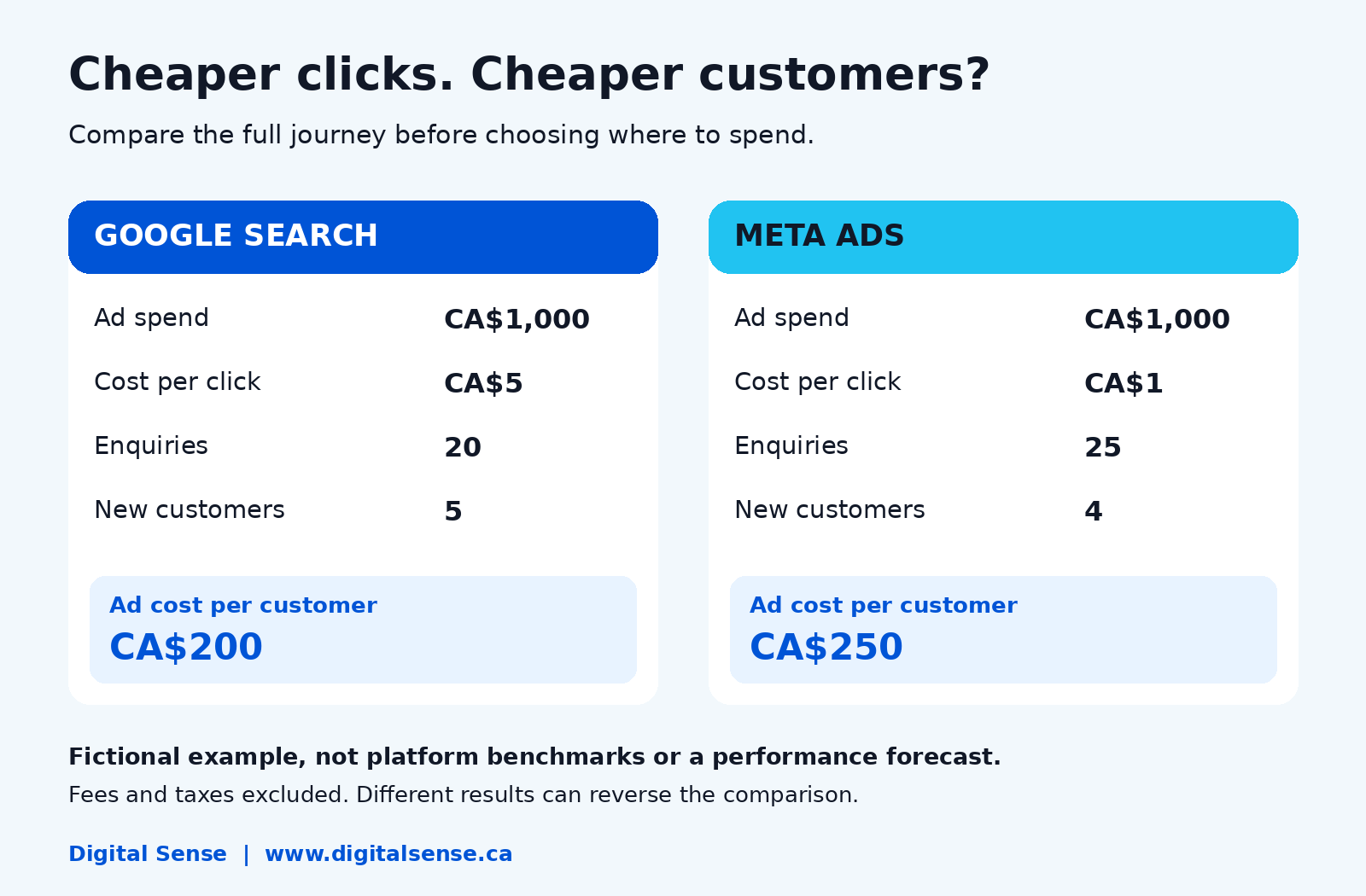
There is no universal cost winner. A lower cost per click can still produce a higher cost per customer if fewer people enquire or buy.
Consider this fictional example. Both campaigns spend the same amount, but the conversion and close rates differ.
| Metric | Google Search example | Meta example |
| Ad spend | CA$1,000 | CA$1,000 |
| Average cost per click | CA$5 | CA$1 |
| Clicks | 200 | 1,000 |
| Enquiries | 20 | 25 |
| Cost per enquiry | CA$50 | CA$40 |
| New customers | 5 | 4 |
| Ad cost per customer | CA$200 | CA$250 |
Illustration only. These are invented inputs to explain the calculation, not platform averages, forecasts or Digital Sense client results. Fees, creative costs and taxes are excluded. All enquiries in this example have completed the same evaluation window.
In this example, Meta has cheaper clicks and enquiries, but Google has the lower ad cost per customer. Change the conversion or close rates and the conclusion can reverse.
Ad cost per customer = ad spend ÷ new customers attributed to that spend
For a fuller comparison, include management, creative production and other acquisition costs. Also consider whether customers from each channel produce comparable margins and repeat business.
Which platform generates better-quality leads?
Lead quality depends on the offer, targeting, qualification and follow-up process. Neither platform label establishes whether an enquiry will become a customer.
A person searching for “free repair advice” may have little intention of booking. Someone who sees a useful product demonstration on Instagram may be ready to buy.
Define a qualified lead before evaluating performance. For a local service business, that might mean someone who:
- Is within the service area.
- Needs a service you actually provide.
- Has a suitable timeframe and budget.
- Can be contacted and has a genuine enquiry.
Track contactable leads, qualified leads, booked appointments and completed sales separately. A campaign generating 40 forms may be less valuable than one generating 12 relevant enquiries, but only your follow-up records can establish that.
How should you choose when your advertising budget is small?
When splitting the budget would leave both campaigns with too little evidence to evaluate, start with the platform best matched to your offer.
Use this decision sequence:
- Choose one outcome. Decide whether the test should produce purchases, qualified enquiries or bookings.
- Check demand. Google Keyword Planner can estimate searches and forecast clicks and costs for selected keywords and locations. Treat forecasts as estimates.
- Check your assets. Review your landing page, photos, videos and enquiry handling.
- Set an acquisition limit. Decide what a customer is worth after delivery costs, overhead and the profit you need to retain.
- Define the test. Choose a spend limit and allow enough time for your normal sales cycle to complete.
You do not need to advertise everywhere to learn something useful.
Should you use Google Ads and Facebook Ads together?
Both can make sense when each has a clear role and the business has the budget and operational capacity to evaluate them.
A customer might discover a furniture store through an Instagram video, later search for the brand and then buy. Another might find a service through Search and revisit it after seeing more information elsewhere.
That makes reporting important. Two platforms may attribute the same sale to their ads under different rules or windows. Do not add platform-reported purchases together and assume they represent unique customers.
Use your order or CRM records to check actual customers and revenue. Review attribution settings and conversion definitions before comparing reports. Retargeting is another possible tactic where audience eligibility and data-use requirements allow it; it should not be assumed to be available or useful for every account.
How can you tell which platform is working better?
Compare the business outcome you chose, using consistent definitions and enough time for leads to mature.
| Business goal | Main outcome to assess | Supporting checks |
| Generate service enquiries | Cost per qualified lead and customer | Contact rate, booking rate and close rate |
| Sell products online | Contribution after acquisition costs | Purchase conversion, order value, returns and repeat purchases |
| Fill appointments | Cost per attended appointment | Booking completion, cancellations and attendance |
| Introduce a new offer | Evidence of relevant interest and subsequent action | Reach and engagement, followed by enquiries or sales |
For sales campaigns, return on ad spend can help, but it measures revenue relative to ad spend rather than profit. Product costs, delivery, returns and fees still matter.
Also separate existing-customer or branded demand from new-customer acquisition where possible. A campaign reaching people already familiar with you is doing a different job from one introducing your business for the first time.
Need help choosing where to spend your ad budget?
You should know why you are choosing a platform before you start paying for traffic.
Digital Sense offers Google and Meta advertising support alongside landing pages and tracking. We can help you discuss the right starting point for your offer, audience and budget.
Give every campaign a clear purpose and every enquiry a clear next step.
Frequently asked questions about Google Ads vs. Facebook Ads
Is Google Ads better than Facebook Ads for local businesses?
Google Search is a useful first test when local customers actively search for the service you provide. Facebook and Instagram may suit offers that benefit from visual discovery. Check local demand, conversion readiness and customer acquisition costs before deciding.
Can Facebook Ads generate sales, or are they only for awareness?
Facebook and Instagram advertising can support conversions and customer conversations, not only awareness. The offer, creative, campaign setup and purchase or enquiry process all affect the outcome. Track completed sales rather than treating engagement as proof of revenue.
How long should you test each advertising platform?
There is no reliable universal test length. Allow time for leads to move through your normal sales cycle and for enough meaningful outcomes to accumulate. Set the spend limit and review criteria before launch. A few clicks or one sale rarely provide a dependable comparison.
Do you need a website to advertise on Google or Facebook?
Standard Google Search campaigns commonly send people to a website, although routes vary by format and eligibility. Meta offers supported lead and messaging experiences that can begin without sending someone to a site. A useful website can still help explain your offer and build trust.
You may also like

Want to know where your customers are slipping away?
A live look at your website, Google listing and follow-up, plus a written report in 48 hours.