 Digital Sense

To respond to a negative Google review, acknowledge the concern, apologise for a confirmed mistake, explain a realistic next step and offer a private way to continue. Keep the reply calm and specific. If the review appears to break Google’s policies, assess whether to report it rather than arguing publicly.
A one-star review can feel personal when you have worked hard to build your business. The temptation is to defend every detail.
But your reply has another audience: the next person deciding whether to call you.
You cannot control every review. You can control whether your response gives that reader confidence in how you handle a problem.
What should you check before replying to a negative Google review?
Check what you can verify, what still needs investigating and whether a policy issue is involved. Do not let a reply get ahead of the facts.
Review the complaint with the relevant team member. Decide who can investigate, what they can offer and how the reviewer can reach them. A reply that promises a callback is only useful if someone actually makes it.
| Review situation | Sensible next action | Avoid |
| A confirmed service mistake | Acknowledge the failure and explain the next step | Excuses or blame |
| A pricing or expectation complaint | Check what was communicated and offer clarification | Calling the customer unreasonable |
| A one-star rating without text | Invite details through a business contact channel | Guessing what happened |
| A reviewer you cannot identify | Ask for enough information privately to investigate | Declaring the review fake |
| Possible spam, harassment or another policy violation | Preserve relevant evidence and assess reporting options | A public argument |
| A demand for payment to remove reviews | Preserve the messages and use Google’s extortion reporting route | Paying or negotiating with the sender |
Not recognising a display name does not establish that a review is fake. The person may use a different name or may have interacted with your business without completing a purchase.
For review extortion, Google advises businesses not to engage or pay and to submit evidence through its dedicated reporting process.
What should a professional negative review response include?
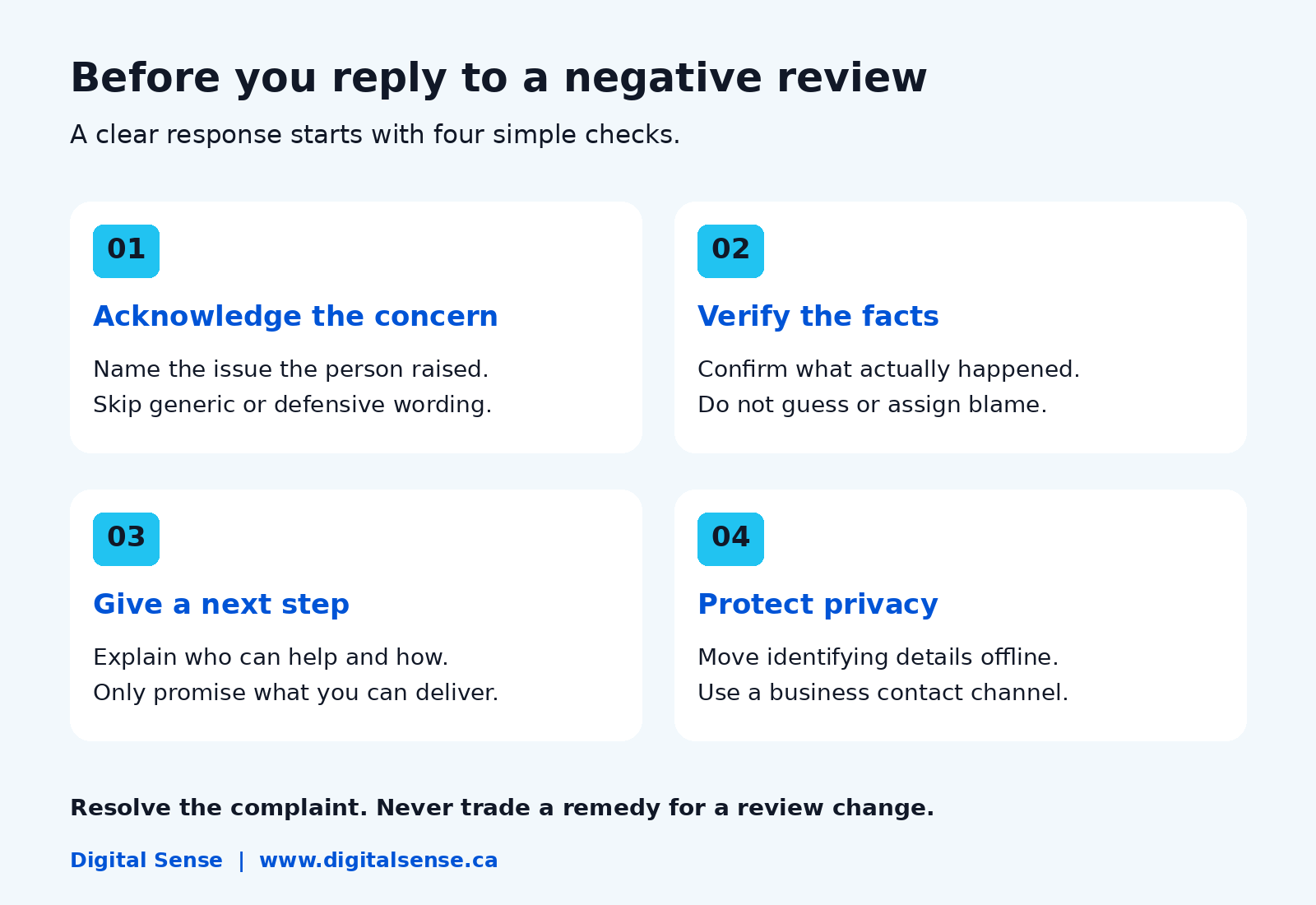
A useful response names the concern and gives the reader a concrete next step. Use this structure as a drafting aid:
Concern → appropriate acknowledgement → next action → private contact
For example, a complaint about an unanswered enquiry needs a way to reach the person handling it. A complaint about an inaccurate quote needs a review of the quote. “We value your feedback” does not explain either action.
Google recommends concise, relevant replies, privacy protection and an apology when appropriate. It also advises businesses to acknowledge actual mistakes without accepting responsibility for matters outside their control.
As an editorial guideline, aim for three to five useful sentences. This is not a Google word-count rule. A shorter response is often enough when the review contains little detail.
Which negative Google review response template should you use?
Choose a template that fits the facts, then replace every bracketed field. These are original example replies, not real customer conversations. Only mention actions you have taken or can deliver.
How do you respond when your business made a mistake?
Use this when you have confirmed the service failure.
Hi [first name], we’re sorry we missed [specific service commitment]. We have [verified action already taken]. Please contact [name or role] at [business email or phone] so we can discuss the next step with you.
For instance, a cleaning company might acknowledge a missed area and arrange a discussion about putting it right. It should not promise a free return visit unless that option has been approved.
How do you reply to a complaint about a long wait?
Use this when the wait has been confirmed. If the cause remains uncertain, leave it out.
Hi [first name], we’re sorry your wait was longer than expected. We should have kept you better informed. [Name or role] would like to look into the delay and follow up with you. Please reach us at [business contact] with the details privately.
Remove the sentence about communication if it does not reflect what happened. A useful apology should be accurate.
How do you respond to a negative review about pricing?
Acknowledge the concern and offer to review what was quoted and charged.
Hi [first name], thank you for raising your concern about the cost. We’d like to review the quote and explain the charges clearly. Please contact [name or role] at [business contact] so we can look at the details with you privately.
Avoid defending your entire pricing model in the reply. First establish whether the issue was the price, an unexpected charge or unclear communication.
How do you respond to a one-star review with no comment?
Invite context without inventing a complaint or apologising for an event you cannot verify.
Hi [first name], we’d appreciate the chance to understand what prompted your rating. Please contact [name or role] at [business contact] with any details you’d like us to review.
A rating without text provides limited information. It is not, by itself, evidence of a policy violation.
How do you reply when you cannot identify the reviewer?
Stay neutral and offer a way to locate the interaction.
Hi [first name], we’d like to look into the concern you’ve raised, but we cannot identify the interaction from the information here. Please contact [name or role] at [business contact] with further details privately so we can investigate.
Use this only after making a reasonable check. Avoid asking the person to post order numbers, contact information or other identifying details publicly.
How do you reply when a review includes an inaccurate claim?
Correct a relevant, verifiable public fact briefly. Leave account-specific disputes for private follow-up.
Hi [first name], we’d like to clarify that [brief, verified public fact]. We would also like to understand the concern you’ve described. Please contact [name or role] at [business contact] so we can review the details with you.
For example, a business could clarify where its current opening hours are published. It should not publish a customer’s private correspondence to prove a point.
How do you respond after the issue has been resolved?
Use this only when the resolution is confirmed and a public acknowledgement is appropriate.
Hi [first name], thank you for giving us the opportunity to address your concern. We’re glad we could agree on a resolution. If you need further help, please contact [name or role] at [business contact].
Keep settlement details private. Do not make the resolution conditional on a higher rating or deletion of the review.
What should you avoid saying in a negative review response?
Avoid language that dismisses the complaint, exposes private information or promises something you cannot deliver.
| Avoid this | Use this approach instead |
| “Sorry you feel that way.” | Acknowledge the specific concern |
| “You are lying.” | Explain what you can verify and invite private clarification |
| “Nobody else has complained.” | Address this experience on its own merits |
| “Here is your order history.” | Review identifying details privately |
| “Delete this and we will refund you.” | Handle any remedy independently of the review |
| “This will never happen again.” | Describe a specific action you can support |
A remedy can address a service problem, but it must not become payment for changing the public record. Google prohibits incentives such as discounts, free services or payment in exchange for posting, revising or removing reviews. [4]
How do you post a reply through Google Business Profile?
Google requires your business to be verified before you can reply. Once signed into the account managing the profile:
- Open your Google Business Profile.
- Select Read reviews.
- Find the review and select Reply.
- Enter your response, check it and select Reply to submit.
Approved replies appear publicly beneath the review. Google notifies the reviewer, who can choose to update their review. You can also edit or delete your own reply later.
Before posting, check the contact details and remove any unfinished placeholders. Read the reply as if you were a potential customer seeing the business for the first time.
When should you report a negative Google review?
Report a review when you can identify a possible policy violation, rather than simply because its rating is low. Google does not remove reviews merely because a business disagrees with them.
Examples to assess against Google’s rules include fabricated experiences, conflicts of interest, harassment and disclosure of personal information. A real complaint may still contain prohibited content, so evaluate the content itself.
From your Business Profile, open Read reviews, choose Report beside the review, select the relevant reason and submit. You can track the decision in Google’s Reviews Management Tool. If Google finds no violation, a one-time appeal may be available through that tool. Reporting does not guarantee removal.
Keep evidence factual. A statement such as “we dislike this review” gives Google no policy basis to assess.
What should you do after replying to a negative review?
Assign the issue to someone, complete the promised follow-up and record whether the complaint points to a recurring problem.
A simple internal log can include the issue, owner, next action and outcome. Keep customer information in an appropriate private system.
If several people mention unexpected charges, review how quotes are explained. If complaints mention unanswered calls, check who handles missed enquiries. Repeated problems need operational changes, not increasingly polished replies.
Continue inviting honest reviews through a neutral process. Do not ask only satisfied customers or offer rewards for positive feedback. Google’s policies prohibit selectively soliciting positive reviews and discouraging negative ones.
Need help managing your Google reviews and local visibility?
Your next customer may read your response before they visit your website. Give them a clear reason to trust how you do business.
Digital Sense offers support with reviews and reputation, Google and local visibility, and customer follow-up. If your reviews are going unanswered or your team needs a consistent process, discuss your next steps with us.
Frequently asked questions about negative Google reviews
How quickly should you respond to a negative Google review?
Aim to respond within one or two business days where practical, after checking the facts. This is a suggested internal service standard, not a Google deadline. More complex concerns may need a brief acknowledgement followed by private investigation. Google recommends timely responses.
Can a business delete a negative Google review?
You cannot directly delete another person’s Google review. You can report a suspected policy violation for Google’s assessment. A reviewer can also choose to edit or delete their own contribution. A negative opinion alone is not grounds for removal.
Should you respond to every negative Google review?
Review each one and prioritise genuine complaints where a reply can help. A short invitation for details can suit a rating without text. Threats, extortion and abusive content need escalation or reporting rather than a public back-and-forth. Avoid repeatedly arguing with the same reviewer.
Does responding to Google reviews improve local SEO?
Helpful replies show that your business pays attention to customers. Google says review volume and positive ratings can help local ranking, but that does not establish that each reply produces a ranking increase. Respond for clarity and trust rather than inserting keywords or city names into every answer.
You may also like

Want to know where your customers are slipping away?
A live look at your website, Google listing and follow-up, plus a written report in 48 hours.