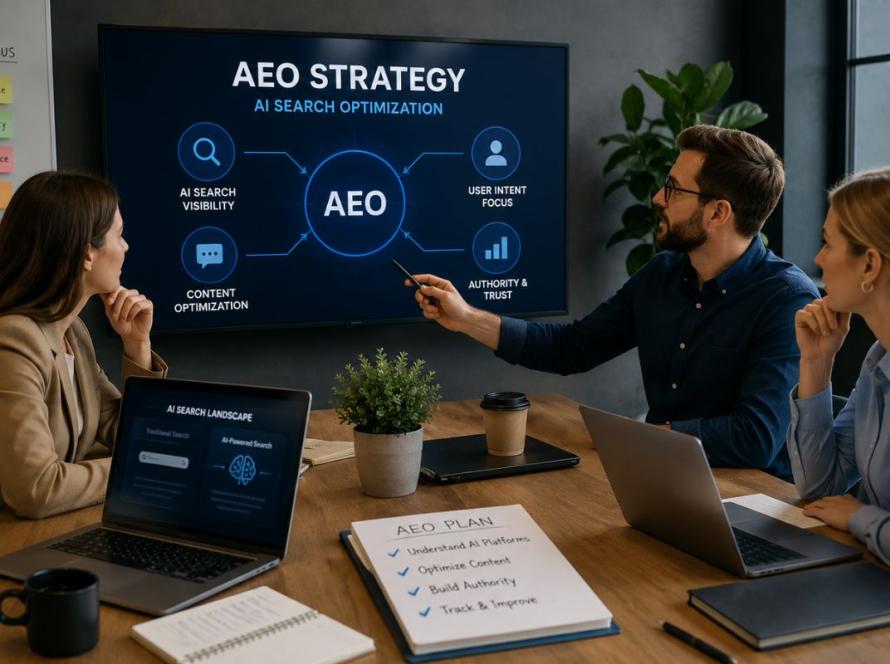
If you’ve noticed Google, ChatGPT, Gemini, Perplexity, and voice assistants answering more questions directly—without sending users to websites—you’re witnessing the rise of Answer Engine Optimization (AEO).
In this new world of AI-driven search, knowing how to do AEO is no longer optional. It’s the difference between being featured as the answer… or being invisible.
This guide will walk you through a step-by-step AEO guide for beginners, explain the difference between SEO and AEO, and show you how to get featured in Google SGE answers using practical, simple techniques you can apply today.
Let’s dive in.
What Exactly Is Answer Engine Optimization (AEO)?
Answer Engine Optimization (AEO) means optimizing your website so AI engines can easily understand, extract, and display your answers. Instead of competing only for rankings, you’re competing to become the answer itself.
AEO focuses on:
- Direct answers
- Structured formats
- Entities & relationships
- Contextual clarity
- Zero-click visibility
In simple words: AEO helps search engines instantly grab your content and display it as the answer people see first.
How AEO Differs from Traditional SEO?
There is a clear difference between SEO and AEO.
- SEO = ranking webpages in the search results
- AEO = ranking answers within AI-driven search engines
AEO uses micro-formatting, question-based headings, schema markup, concise answers, and entity SEO so Google SGE, Gemini, ChatGPT, and Bing Copilot can extract your content easily.
SEO brings users to your site.
AEO brings visibility even when users don’t click.
Core Principles of High-Performance AEO:
AEO works best when your site follows these foundational principles.
Answer First, Explain Second:
Start every section with a short, direct answer.
Then expand with context, examples, and insights. This is the core of how to optimize a website for AEO.
Keep Each Answer Under 40–50 Words:
AI engines love concise, complete responses.
This length is perfect for Featured Snippets, voice search, and Google SGE answer boxes.
Use Conversational, Natural Language:
People increasingly search using:
- “How do I…?”
- “What is the best way to…?”
- “Why does this work?”
Write the way people talk. This is essential when learning how to do AEO effectively.
Provide Structured, Scannable Formats:
Use:
- Bullet points
- Numbered lists
- Tables
- Quick summaries
These formats help AI systems identify relationships and meanings instantly.
Build Entity Strength:
Mention:
- Your brand
- Services
- Industries
- Locations
- Certifications
- Related concepts
The stronger your entity footprint, the easier it is for AI to categorize you correctly.
Step-by-Step: How to Do AEO for a Website (The Practical Process)
This is the part everyone wants — a step-by-step AEO guide for beginners that’s easy, practical, and results-focused.
Step 1 — Start With Question-Driven Keyword Research:
Your AEO journey begins with identifying the exact questions users are asking.
Use tools like:
- People Also Ask
- Google SGE previews
- AlsoAsked
- AnswerThePublic
- ChatGPT queries
Create question clusters, not keyword lists. Group questions by:
- How
- What
- Why
- When
- Problems
- Comparisons
These clusters become your AEO roadmap and help you learn how to optimize a website for AEO with absolute clarity.
Step 2 — Create Short Answer Blocks:
Each section should start with a 40–50 word direct answer.
Every answer block must include:
- A short, accurate answer
- A detailed explanation
- Examples
- Context
This is a secret most people overlook when learning how to do AEO successfully.
Step 3 — Use Schema Markup (Mandatory for AEO)
Schema markup helps AI engines understand your content structure.
Use:
- FAQ schema
- How-to schema
- Article schema
- Product schema
- Organization schema
- Video schema
- Breadcrumb schema
Stick to JSON-LD. It’s clean, clear, and loved by Google SGE.
Step 4 — Optimize for Voice Search & AI Chatbots:
Voice search queries are longer, more conversational, and more question-based.
To get picked up:
- Write in Q&A format
- Use clear, simple sentences
- Ensure “semantic completeness” — cover related concepts thoroughly
This significantly increases your chances of appearing in Google SGE answers.
Step 5 — Improve Your E-E-A-T Signals:
AI models prefer authoritative content.
Show E-E-A-T by:
- Adding author bios
- Citing industry stats
- Using real examples
- Adding case studies
- Linking to trusted sources
- Showing certifications
Strong credibility boosts your selection rate in AI-generated summaries.
Step 6 — Organize Pages With Clear Topical Architecture:
AEO prefers websites with structured topics, such as:
- Content clusters
- Topic hubs
- Internal linking
- Category-based organization
- Hierarchical URLs
Better structure = higher visibility in Google SGE.
Step 7 — Optimize Images & Videos for AEO
AI engines do analyze non-text elements.
Make sure your media:
- Uses descriptive filenames
- Includes meaningful alt text
- Answers a question
- Utilizes VideoObject schema
- Includes captions
This helps you stand out in rich results and SGE snapshots.
Step 8 — Create AEO-Friendly Internal Linking:
Internal links must be intentional and question-focused.
Use anchor text like:
- “Learn how to optimize a website for AEO”
- “See the difference between SEO and AEO”
- “Check AEO errors to avoid here”
This strengthens semantic relevance across your entire website.
AEO Content Formats That Perform Best:
Understanding which formats AI loves gives you a serious advantage.
Short Answer Cards:
These are 30–50 word summary blocks that Google SGE often displays.
How-To Guides:
Clear steps, lists, visuals, and schema perform amazingly well.
Comparison Tables:
AI engines love comparisons because they remove ambiguity.
FAQs:
Ideal for voice search, conversational queries, and AI-powered engines.
Problem + Solution Formats:
Perfect for capturing intent-based queries like “AEO errors to avoid”.
Common AEO Mistakes to Avoid:
These are critical AEO errors to avoid because they can sabotage your visibility.
Over-stuffing with keywords:
Keyword stuffing confuses AI signals and reduces clarity.
Not adding schema markup:
Without structured data, your content becomes difficult for AI to extract.
Writing long intros before giving the answer:
AEO expects you to answer first, explain later.
Weak entity descriptions:
If your brand doesn’t show strong identity signals, you won’t rank in AI engines.
Mixing multiple questions in one section:
One question per section → one clean answer block.
AEO Checklist (Use This Before Publishing):
Before hitting publish, ask yourself:
- Does every H2/H3 start with a short answer?
- Are questions written naturally?
- Is schema markup added?
- Are FAQs included?
- Are answers 40–50 words?
- Does the page show E-E-A-T?
- Did you cover related queries?
- Is internal linking supporting topical relevance?
- Are images/videos optimized for extraction?
If you checked YES for most of these, your AEO setup is strong.
Conclusion — AEO Is Not Optional Anymore:
AI engines now extract answers, not paragraphs.
Businesses that learn how to do AEO stand out even when clicks drop.
When done right, AEO for a website helps you achieve:
- More impressions
- More zero-click visibility
- More authority
- More AI-powered search traffic
The future of search belongs to brands that combine:
- SEO
- AEO
- Structured Data
- Entity Optimization
Those who adapt will dominate visibility in Google SGE, ChatGPT search, and all major AI engines.
FAQs
What is the first step in Answer Engine Optimization?
The first step is performing question-based keyword research. Identify what users are asking—how-to queries, comparison questions, troubleshooting topics, and intent-based queries. Then transform each question into a short, 35–50 word answer block.
How long should an answer be for AEO?
The ideal length is 35–50 words because AI-based search results and voice assistants prefer concise, complete answers. This length helps Google SGE extract and display your content accurately.
Do I need schema markup for AEO?
Yes. Schema markup is essential. Without schema, AI engines cannot fully understand your page structure. FAQ, How-to, Article, and Organization schema significantly increase your chances of appearing in AI-generated answers.
Does AEO replace SEO?
No. AEO complements SEO. SEO helps your website rank, while AEO helps your answers rank inside AI-driven search results. Both work together to maximize visibility in 2025 and beyond.